


In industrial piping systems, the quality of pipe fittings directly affects the safety and service life of the entire transmission network. Recently, a series of FRP pipe fittings manufactured using advanced composite material technology has attracted widespread attention in the market, especially the new type of fitting represented by FRP reducing flanges. With its advantages of corrosion resistance, lightweight and high strength, and convenient installation, it is gradually replacing traditional metal pipe fittings and is widely used in chemical, environmental protection, power, and marine engineering fields.
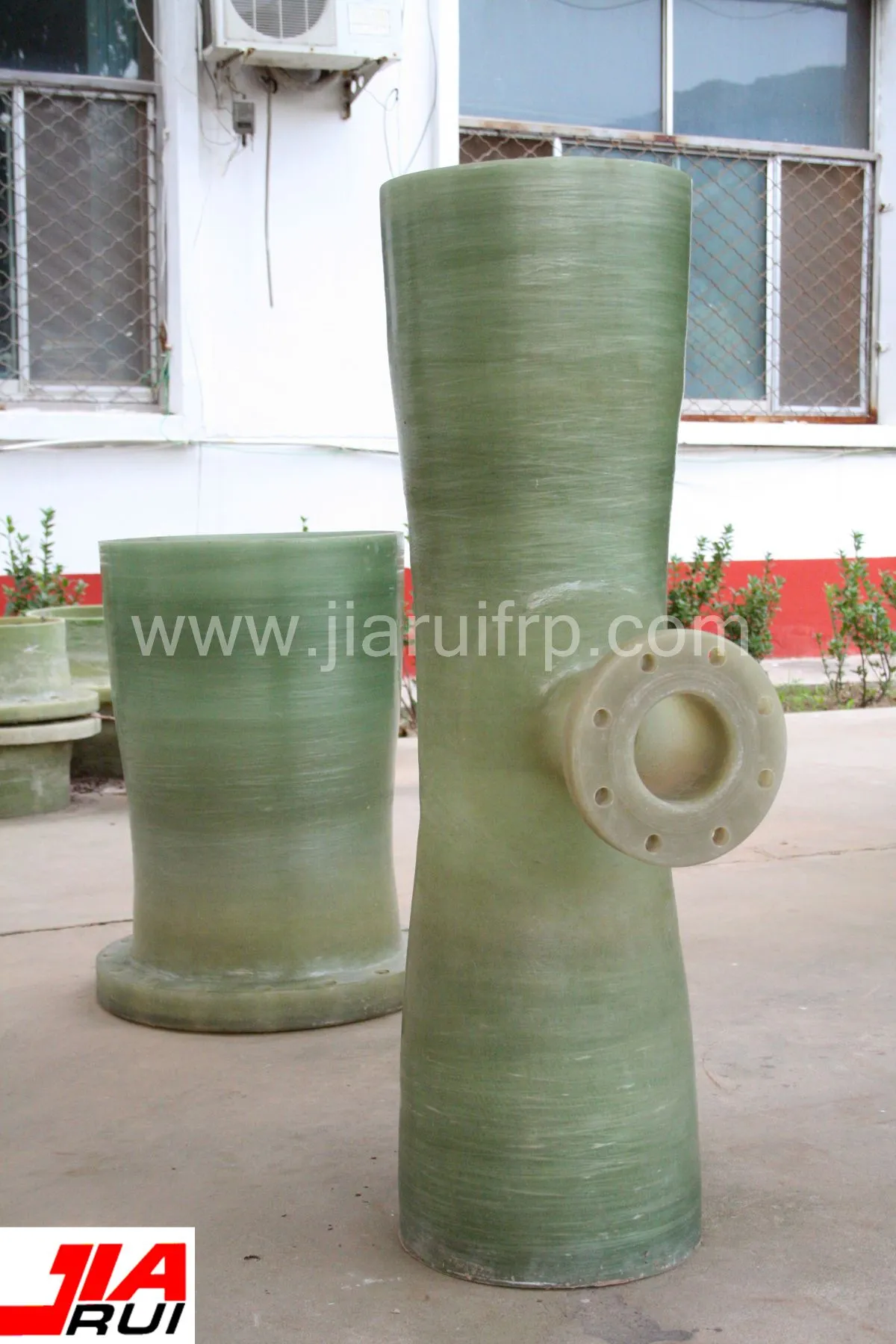
In complex piping layouts, the need to connect pipes of different diameters is very common. Traditional reducing pipe connections often suffer from installation difficulties, poor sealing, and susceptibility to corrosion. The newly launched FRP reducing flange integrates the reducing pipe and flange into a single unit, ensuring a smooth flow transition and eliminating weak points caused by welding or bonding through an integral winding process. As shown in the figure below, this product has a compact structure and a flat flange end face, which can be used with rubber gaskets or O-rings to achieve high-pressure sealing.
From a technical perspective, this fiberglass reducing flange has a pressure rating ranging from 1.6MPa to 4.0MPa and a temperature range of -40℃ to 120℃. It can withstand various corrosive media, including strong acids, strong alkalis, salt spray, and organic solvents. Its weight is only about one-quarter that of a carbon steel reducing flange of the same specification, yet it provides a strength close to that of steel, significantly reducing the load-bearing requirements of pipe supports and eliminating the need for heavy lifting equipment during on-site installation.
For project managers, choosing high-performance GRP piping not only ensures safe system operation but also significantly reduces long-term maintenance costs. For example, in a coastal chemical plant's brine transmission pipeline, the previously used carbon steel reducing pipes needed replacement every two years due to corrosion and perforation. After being replaced with fiberglass reducing flanges, it has operated continuously for five years without leakage, and the pipe surface remains intact. Calculations show that although the initial procurement cost is slightly higher than that of ordinary carbon steel products, considering the reduced downtime maintenance costs, anti-corrosion coating maintenance costs, and spare parts inventory, the incremental investment can be recovered within three years, with subsequent annual maintenance savings exceeding 40%.
To meet the specific requirements of different industries, manufacturers can provide customized pipe fitting services for non-standard sizes. For example, in flue gas desulfurization systems, pipe fittings are required to have both wear resistance and temperature resistance; in the food and pharmaceutical fields, a mirror-like finish on the inner surface is needed for easy cleaning. Fiberglass reducing flanges can also be manufactured according to customer-provided interface standards (such as ANSI, DIN, and JIS), with the number of flange bolt holes, distribution circle diameter, and sealing surface type all customizable. Furthermore, the default product color is grass green or gray, but UV absorbers or flame-retardant resins can be added upon request to suit outdoor exposure or fire and explosion-proof environments.
With the increasing national requirements for environmental protection and industrial safety, lightweight, high-strength, and corrosion-resistant composite material pipe fittings are experiencing rapid growth. Market research data shows that the global FRP pipe fittings market is projected to grow at a CAGR of over 7% between 2023 and 2028, with the Asia-Pacific region being the main growth engine due to the large-scale renovation and upgrading of aging pipelines.
It is worth noting that specific operating procedures must be followed when installing FRP reducing flanges: flange bolts should be tightened evenly in stages using gaskets and a cross-tightening method to avoid unilateral overload that could lead to flange deformation or cracking; when connecting pipes, the larger end of the reducer should ideally be aligned with the direction of medium flow to reduce turbulence; if used for outdoor overhead pipelines, a guide support should be installed every 6-8 meters to prevent vibration-induced fatigue at the interface. A properly installed FRP reducing flange can have a design service life of over 20 years.
In conclusion, new FRP pipe fittings, represented by FRP reducing flanges, are becoming an ideal choice for modern industrial piping systems due to their comprehensive economic advantages and technical reliability. For more information on product specifications, pressure ratings, or to obtain selection calculation tables, please visit our product center or contact us directly.