


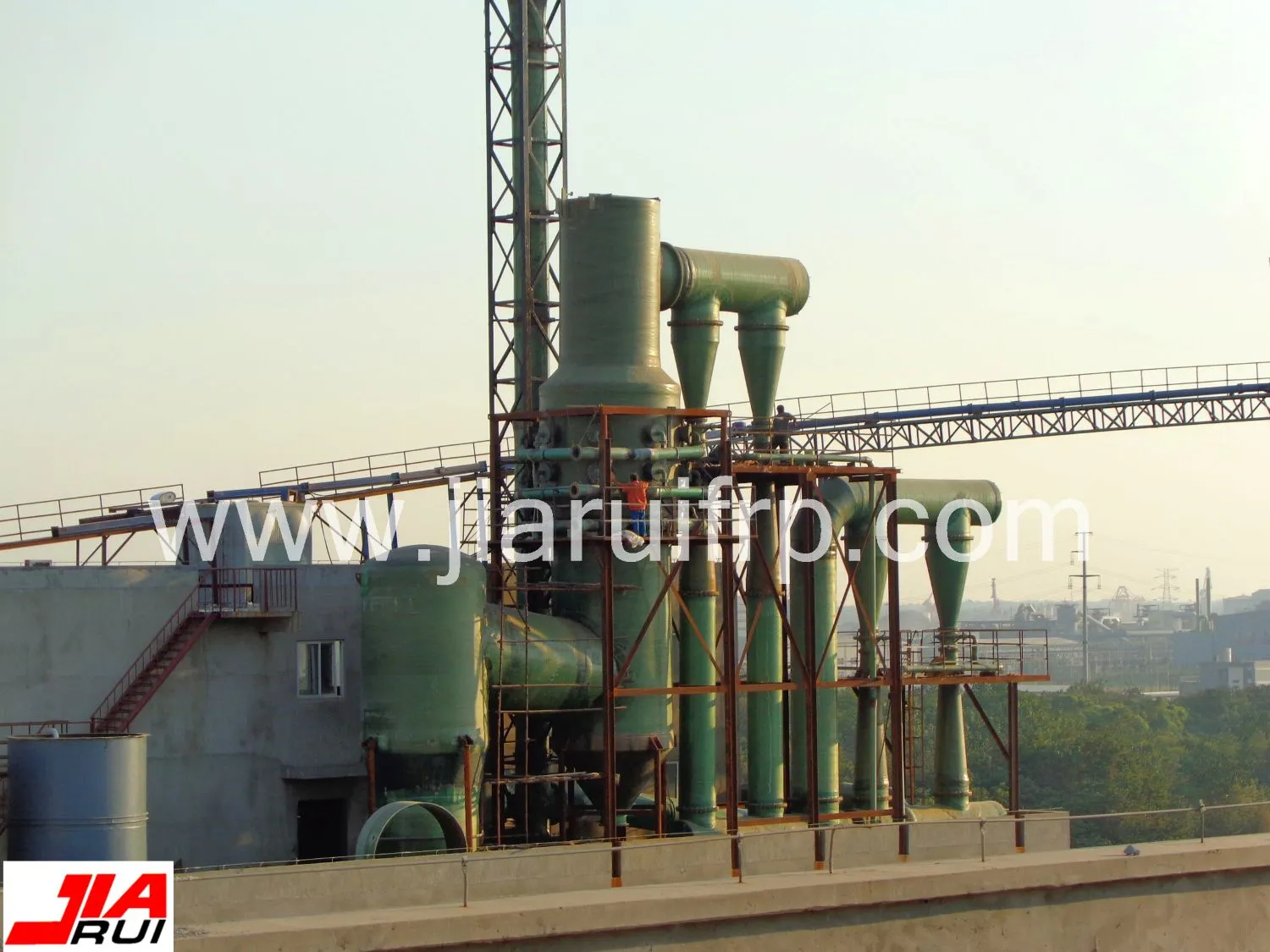
With increasingly stringent environmental regulations and continuously tightening industrial emission standards, the efficient treatment of acidic waste gases generated during production processes has become a serious challenge for industries such as chemical, electroplating, and electronics manufacturing. As a new type of waste gas purification device made of fiberglass reinforced plastic (FRP), the FRP acid gas scrubber, with its excellent corrosion resistance, stable operation, and high purification efficiency, is gradually replacing traditional metal scrubbers and becoming the preferred solution for waste gas treatment in many enterprises.
Mature Application of GRP Towers in Waste Gas Treatment
The FRP acid gas scrubber, also known as a fiberglass acid mist purification tower or FRP packed absorption tower, is an important branch of GRP (glass fiber reinforced plastic) towers. The main body of this equipment is made of glass fiber reinforced plastic (FRP), with flame-retardant vinyl unsaturated resin as the matrix and alkali-free untwisted glass fiber as the reinforcing material, and is integrally processed through winding or hand lay-up molding processes.
The equipment adopts a vertical cylindrical segmented flange connection structure, mainly composed of core components such as the tower body, liquid storage tank, packing layer, spray system, demister layer, and circulation system. The core working principle of the scrubbing tower is "countercurrent contact + gas-liquid neutralization"-acidic waste gas enters from the bottom of the tower and flows upward under the action of the fan; alkaline absorbent liquid (usually sodium hydroxide solution) is sprayed down from the top of the tower, making full contact with the waste gas on the surface of the packing layer. Through a gas-liquid two-phase neutralization reaction, the acidic components are converted into neutral salts and water. The purified gas is then dehydrated by the demister layer and discharged in compliance with standards. The packing layer uses high-performance packing such as Pall rings or circular patterned rings, with a specific surface area of 620 to 2500 m²/m³, significantly improving the gas-liquid contact efficiency compared to traditional packing.
Why FRP Material is the Preferred Choice
The widespread use of the scrubber in many industrial scenarios is mainly due to the following outstanding advantages:
(I) Excellent corrosion resistance-this is the core competitiveness of FRP material. FRP (glass fiber reinforced plastic) exhibits excellent resistance to air, water, and general concentrations of acids, alkalis, salts, and various oils and solvents, and is replacing traditional metal materials such as carbon steel and stainless steel in the chemical corrosion protection field. Its high resin content structure enables it to withstand long-term erosion from various highly corrosive gases such as hydrochloric acid mist, sulfuric acid mist, hydrofluoric acid, and nitrogen oxides, effectively avoiding the defect of metal materials being easily corroded and failing by acid mist.
(II) Lightweight and High-Strength, Easy Installation-The relative density of FRP is only 1/4 to 1/5 that of carbon steel, but its tensile strength is close to or even exceeds that of carbon steel. While ensuring structural strength, it significantly reduces the self-weight of the tower, making transportation and installation more convenient.
(III) Stable Operation and High Purification Efficiency-The empty tower velocity of the FRP acid waste gas scrubbing tower is generally controlled at 0.5~1.2 m/s, and the purification efficiency can generally reach 85%~95%, and under some optimized designs, it can even reach over 98%. The smooth inner wall of the tower is not prone to scaling and clogging, and with the help of a circulating spray system, the absorbent can be reused, significantly reducing operating costs.
(IV) Long service life and low overall maintenance cost-High-quality FRP products have a design life of 8 to 15 years. The external gel coat resin coating has anti-UV aging properties and can adapt to working environments from -50℃ to 120℃. Compared to steel towers which require frequent anti-corrosion maintenance and PP materials which are prone to deformation and aging at high temperatures, FRP has a significant advantage in overall maintenance costs during long-term operation.
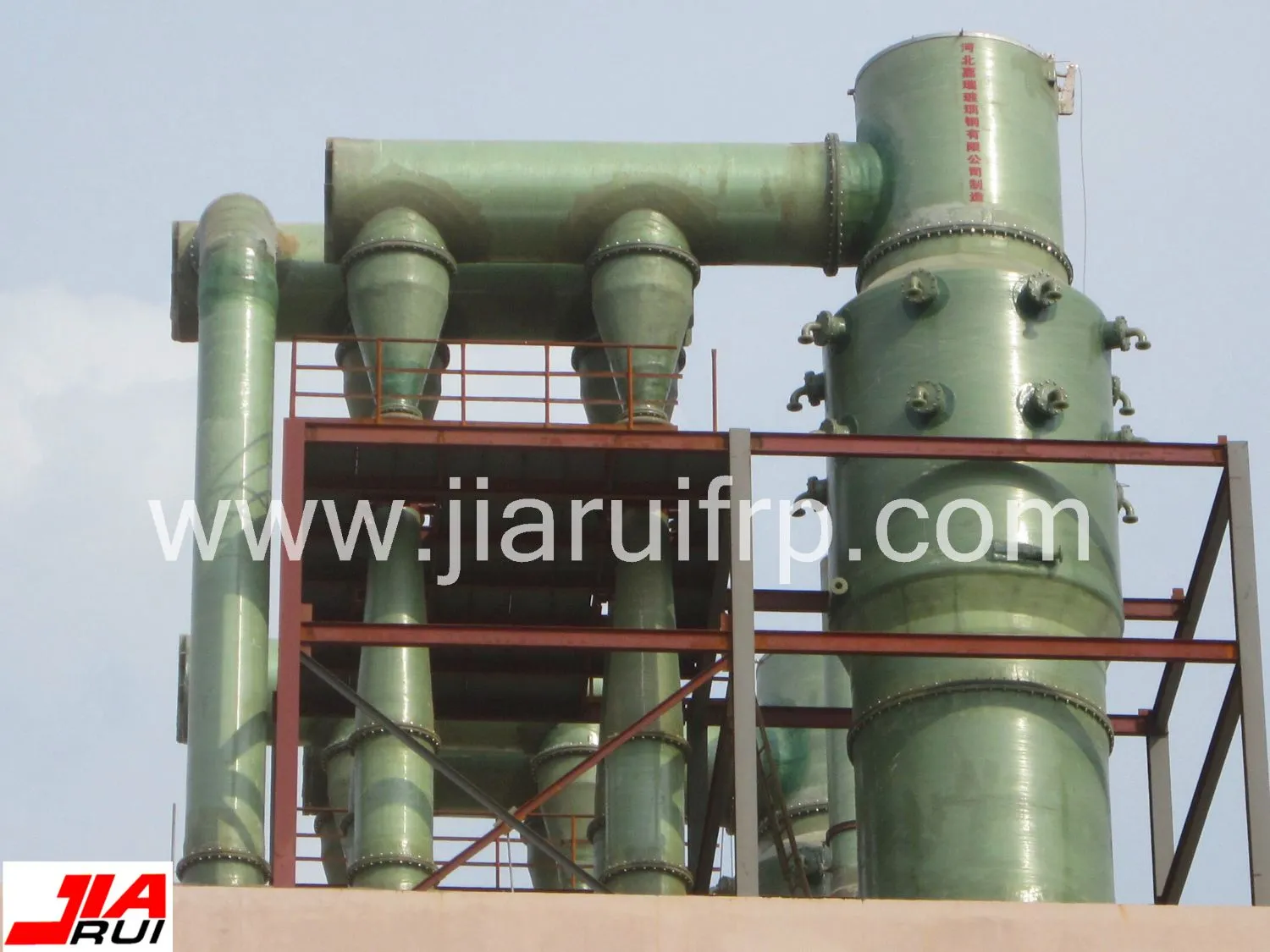
FRP tower products have the following significant design features:
Optimized packing layer design-The tower packing is made of corrosion-resistant materials such as PP or CPVC, and is mostly composed of regular packing structures such as Pall rings, stepped rings, or multi-faceted hollow spheres. This results in high porosity, low pressure loss, and high specific surface area, providing ideal mass transfer conditions for gas-liquid contact.
Multi-layer spray system-Typically, 2 to 3 layers of high-pressure spiral nozzles are configured, achieving a coverage rate of over 95%. The liquid-to-gas ratio is controlled at 2 to 3 L/m³, ensuring sufficient contact between the spray liquid and the waste gas.
High-efficiency demister – The tower top is equipped with a combined cyclone plate and baffle plate demister, achieving a removal efficiency of over 95% for droplets with a diameter of 5 micrometers or larger, effectively preventing the "white fog" phenomenon during purified gas emission.
Modular structure design – The tower body adopts segmented flange connections, allowing for flexible adjustment of the tower height according to site conditions and treatment requirements, facilitating transportation, installation, and subsequent maintenance.
Covering the Waste Gas Treatment Needs of Multiple Industries
GRP tower have been widely used in industrial fields that generate acidic waste gases, such as chemical, metallurgical, electronics, electroplating, semiconductor, and pharmaceutical industries. Specifically, this includes:
Chemical industry – Strong acidic gases such as hydrochloric acid mist, sulfuric acid mist, and nitrogen oxides emitted during the production processes of chlor-alkali plants, fertilizer plants, and pesticide plants.
Electroplating and surface treatment industry – Chromic acid mist and hydrofluoric acid mist generated from processes such as electroplating tanks, pickling lines, and anodizing, as well as acidic waste gases from steel pickling production lines.
Electronics and semiconductor manufacturing-processes such as PCB etching, wafer cleaning, and solar silicon wafer pickling generate fluorine-containing waste gases and organic acidic gases.
Why Choose our scrubber?
FRP acid gas scrubbers, with their superior corrosion resistance, excellent purification efficiency, stable operation, and low overall maintenance costs, have become an ideal solution for waste gas treatment in industries such as chemical, electroplating, and electronics. Especially for working environments with complex waste gas compositions and strong corrosiveness, FRP material has irreplaceable advantages over alternative materials such as PP and stainless steel. As an important member of the GRP tower product family, FRP acid gas scrubbers are continuously driving the iterative upgrading of industrial waste gas treatment technologies.